
What should our tools leave unfinished?
As a designer whose workflow seems to be changing almost every month, I have been thinking a lot about what our tools do to us. How do our tools change our thinking, and how can we make them better not just faster?
Abstractions and Toolpaths
In digital tooling the controls are abstractions. Some controls are representations of physical actions (slicing film, drawing, erasing) but the gesture of using these operations is still a click or a slide across a trackpad. We learn what each abstraction does and how to chain them together to get to the output that we want. Sometimes along the way we might be surprised. We might unearth an unknown effect and then that “toolpath” becomes part of our personal kit of paths we might use in the future.
The transition from physical to digital workflows led to a GUI of panels and actions being chained into digital toolpaths. We click, hover, slide, or scroll. Now the transition from deterministic digital to a generative digital world has resulted in new kinds of abstractions.
Text can turn into a fully rendered image. Word choice, intention, and semantics are instruments in our effort to control our outputs. The toolpaths are not defined yet, but to gain control over this process people have added skills files, developed node based interfaces, and now introduced dedicated “riffing” and “remixing” workflows.
Manager World
However, in our efforts to “steer” we are moving farther away from the process of making and discovery and towards workflows of management and supervision. The goal seems to be to enable an ever more abstract idea to go in while a completed artifact comes out. Previously, the nature of the tools we had available to us forced a kind of roving in how we explored an idea. Now we can “fast forward” to multiple universes of fully polished outputs. We may even like them as long as we steer properly and with good taste and discernment.
But is this really what we want from our tools? Is discernment really a step at the end or something that is built through the gesture of creation?
Tools as mediums and stepping stones
I think we can reimagine both our abstractions and the point on the “artifact” journey that we want new design tools to take us. This is important because we need to start thinking about tools not just as accelerated paths to outputs, but as mediums for making and thinking. Today, AI has a placement problem, and a resolution problem.
So what might it look like to move augmentation earlier in the journey and shift away from todays focus on abstract input to finalized output?
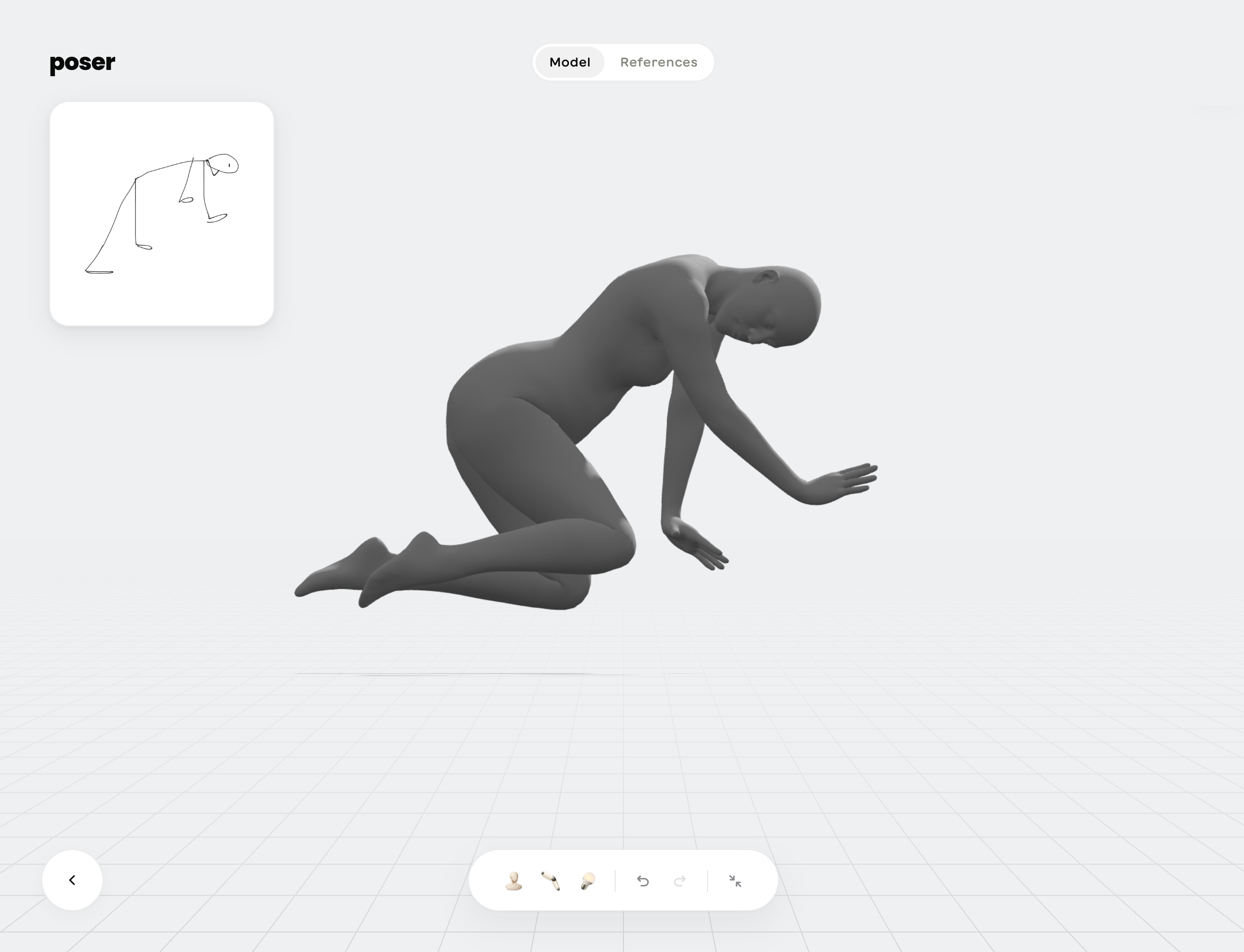
What material should automation leave you with?
Poser lets someone sketch a pose of interest and receive a rigged and parameterized 3d model that corresponds to that sketch, and historical references of pose matched artwork from the MET. It is a creative tool that treats machine learning and generative AI as steps integrated into a tedious part of a workflow rather than accelerants to a final rendered output. I built Poser because I wanted it. It was an emergent tool. Almost like a custom jig for what I was already working on.
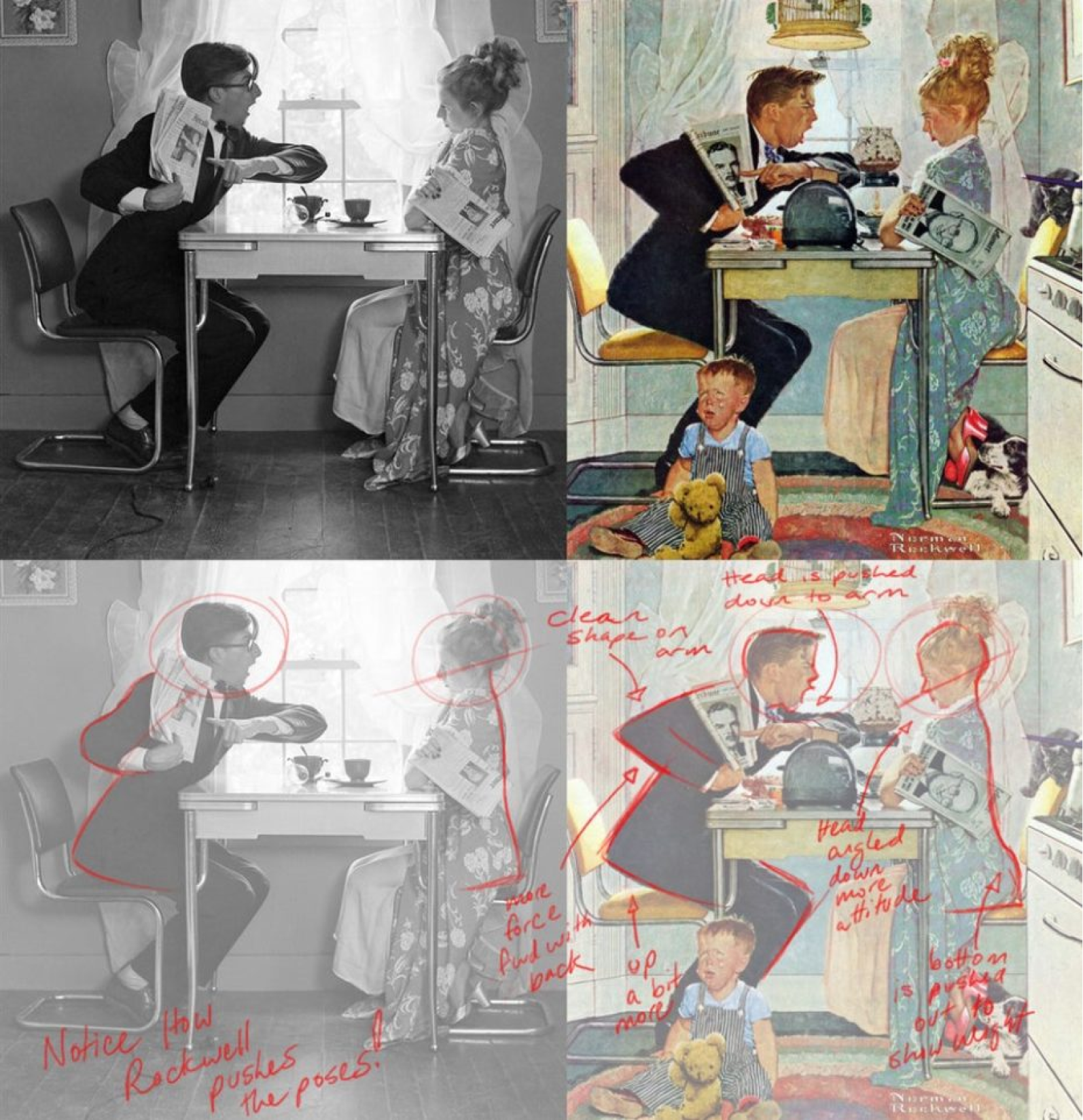


References are a deep part of beginner and professional artist's workflows. Artists don't all pull perfectly formed figures from their mind, but rather seek out or create references that they then interpret. Often I know what general pose I want to render, but finding it is a tedious hunt or I have to set up a self timer and contort myself into the right view.
I could type in what I imagine or even draw a sketch and get a generated image to draw from, but that output is visually resolved. Details, lighting, tweaks in the figure become another back and forth prompt that results in assumptions and visual decisions from the underlying model. It feels like a hollow workflow, where my focus shifts from creation to how to best describe intention to a blackbox system.
The initial idea is a precious thing, uncertain and an opportunity for exploration. It has an energy to it that can deflate when faced with resolved assumptions. The point was never to get to a polished image, but to create that image from my hand and engage in the challenge of creation. Poser is a step on that path, but the creation of the final image, and even of the final pose is in my hands.
The video could not load. You can still read the walkthrough alongside it.
The sketched input is a moment I can develop my intention and create a query.
Matches let me choose which pose best matches my intent
Then the input shrinks and the hierarchy shifts to refinement and exploration within a more familiar workspace of panels and controls.
I can adjust lighting, rigging, and the model itself.
The context of figurative art is situated in deep history. References allow me to encounter methods of rendering across drawing and sculpture from the Mets collection.
Poser pulls together a playground of contexts, mediums, and gestures to create a world where you can explore interpretations, perfect the compositions, and then return to your practice with the references you need. It leaves you with the raw material that one can then interpret.
Poser is just one example. We have a sea of new capabilities from embedding models, VLMs, segmentation models, world models, and generative models, alongside established techniques for parametric modeling, rigging, and simulation. Creation has never been only about “steering” but rather the merging of contexts, the interpretation of gesture, and the desire to do the work. If we thoughtfully enable the construction of new toolpaths we can develop tools that feel good to use and that enable us to bring together more contexts than ever before without treating the speed to final artifact as king.